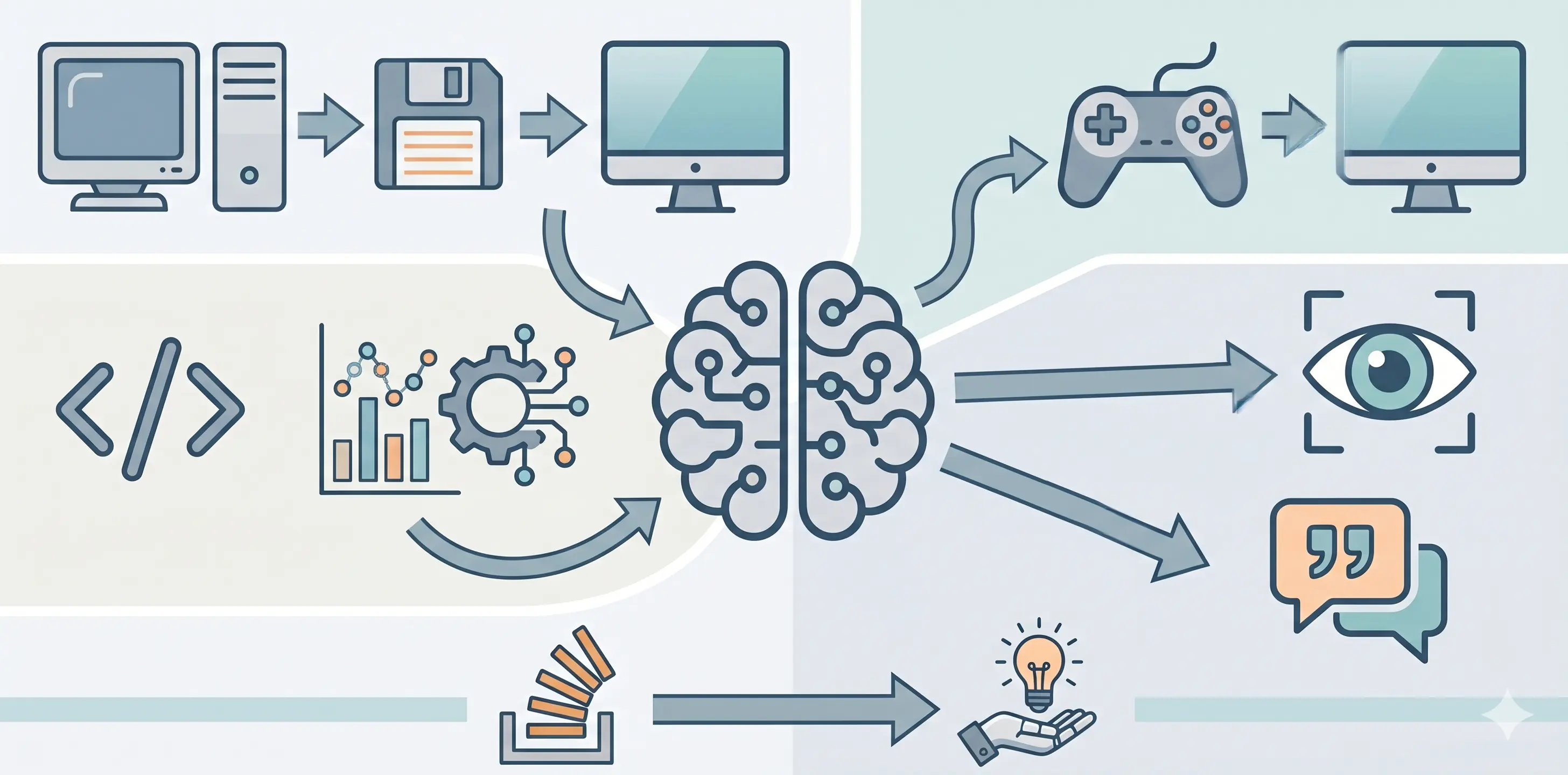
Technical Interests Journey
Introduction
This blog post is dedicated to looking back on how my interests have shifted over the years, since I’ll be leaving the age of 25 — a quarter of a century — soon enough.
Early Days
Throwback to when I was a little kid, around 3-5 years old. I saw my dad using a computer, and he introduced it to me. The computer at that time:
- used a CRT monitor — I sometimes got shocked when touching the screen
- still used a diskette drive or floppy disk drive (FDD) — yes, the one that became the save icon
- used a mouse with a ball underneath — no, not a trackball, just a regular mouse with a ball
- ran on Windows 98 and Windows XP — yes, that one with the scenery
I thought it was very interesting how they worked, as simple as “ooh, technology.”
Elementary School Era
The computer in this era got upgraded really fast in terms of development. I got to know what flashdisks, CD drives, DVD drives, and so on were. I even got introduced to computer software at school, because we had an IT subject — we learned how to use MS Word, Excel, PowerPoint, etc. The higher the grade, the more advanced the IT subject got. And I excelled in it, always getting excellent grades.
I got my first cellphone (and the number) in this era. I still have the same number today, unchanged. I played phone games as well. And I noticed in this era, the phone itself was rapidly evolving into a smartphone. I experienced the 12-button phone where I had to double- or triple-press to get a specific letter. I experienced the BlackBerry Era even though I didn’t own one, but I got the Sony Walkman phone series with the sliding body.
In this era, I also got to know what a modem was, how it worked in general, and how it connected to the internet. It made that unique beeping sound when trying to connect — we needed to “Dial Up” first so it could connect to the internet.
Then in this era, I got to know about video games, especially online games. My friend introduced me to a game called Lost Saga, from a publisher named Gemscool. From there, I played these online PC games as starters: Lost Saga, Point Blank, Dragon Nest — all provided by Gemscool.
Not only online games — I got to know offline games as well, since I got my own PS2 and played a lot of PS2 games. GTA San Andreas, Gran Turismo 4, NFS Underground 2, those Lego series games, and many more. I learned about game cheats as well, and I memorized a lot of cheat codes clearly, especially for GTA San Andreas. I played PC games too, and I learned how to crack games and install them on my PC. My friend and I even tried to sell PC games on CD/DVD discs at a school event, around grade 3-5. And I think I started to know Counter Strike 1.6 at this time as well, but it was offline and played on LAN with my friends in the computer lab.
So at this point, I really started to have an interest in the technical side of PCs and their components.
Junior High School Era
In this era, I got my first netbook (the small one) at grade 7, then got a laptop at grade 8 or 9. My gaming hobby started to flourish since I got to know a game platform called Steam, and from there I got to know Counter Strike: Global Offensive and other Steam games. And at this phase, my phone upgraded to full touchscreen — I think it was a Samsung Galaxy series.
With more access to online games, higher specs of technology, and so on, I started to realize that technology was growing rapidly — in terms of device design, the technology itself, software, the advancement of gaming technologies, and so on.
The IT subjects in this era started to get more advanced, but I still excelled in them. And in this era, I got to know what “Torrent” was and what “peer-to-peer” technology was. The technology is for sharing files between a seeder and a leecher. A seeder is the actor that has the file, and a leecher is the one that downloads the file. The more seeders it has, the more sources of the file are available, which improves the download speed. The more leechers, the more bandwidth gets sucked from the respective seeders.
These kinds of technologies that I got to know, and the rapid advancement of them, made me more interested in it.
Senior High School Era
Here I got my first PC build. It was an Intel build, with a GTX 1050 Ti. Already powerful enough to play online games, since I got more into playing games in this era while getting to know a lot of friends with the same hobby.
In this era, I got introduced to Bitcoin, cryptocurrency, and mining. I didn’t fully grasp the technology at that time, but I did grasp that we could mine cryptocurrency, save it in a digital wallet, transfer it, and make money from it. Because of this, I somehow managed to convince one of my best friends to build a mining rig — with GTX 1060/1070/1080 (I forgot which one), and also with RX 580. My best friend bought like 6 or 8 of each (the GTX and the RX, respectively) and built the rig to mine Ethereum at that time.
At school, of course, I still excelled in the IT subjects. By this time, the subjects were getting more advanced, since I got introduced to HTML and the surface of web development. Then I got to know networking, where I learned how to make a LAN cable myself with crimping tools.
At this time as well, I got to know “coding” and the world around it. I got to know what “open-source” meant — the terms, the software, and so on. One of my friends invited me to do Google Code-In, a competition where we participated by doing tasks for open-source organizations. The friend who invited me to that competition won the top 2 contributor spot for the organization he chose, and he went to Google HQ with the other winners and top contributors from the other organizations that participated as partners of Google Code-In.
This era is where my interest in the general IT world peaked, and it became the pivot of my life where I got to pursue this IT track — I got admitted into UGM with the major of Information Engineering, even though it was my second choice. My first choice was Management.
Bachelor Studies
Here I got my very first hands-on experience with the IT world, especially coding and AI. The first year was packed with basic sciences like mathematics and physics, with only a surface-level introduction to the IT world and programming. In the second year, the science subjects became more advanced, but the credits were now balanced with the IT field, which was also going more advanced as well.
During the first two years, I had my eyes (and interest) on the Data Science field. I tried to understand what it was, what people in the field usually do, etc. And from there, I got experience in the AI/ML field in general.
Then comes the third year, where I chose the concentration of Information System Engineering, but eventually pivoted into Computer System Engineering in the middle of the third year due to a single course: Computer Vision. That course finally captured my interest at its best. But at the same time, I took the Natural Language Processing course, which I was bad at and thoroughly hated. And during this year, I decided I wanted to pursue a master’s degree and deepen my interest areas in the Computer Vision realm.
The fourth year, I just focused on my bachelor thesis project, where I joined a capstone project team to build an online lectures monitoring system. But due to the composition of the team, I decided to do the full-stack software engineering side to create the software instead of the algorithm. So, in the end, I created and engineered a proof of concept for the online lectures monitoring application. During this time working on the bachelor thesis capstone project, I realized I had a love-hate relationship with full-stack engineering, but I could still do it.
In this era, I also realized at a certain point that I hated the role of Data Engineer — but later, after graduation, the Data Engineer role was the one that gave me my first real hands-on experience in the job world, where I became an intern for a startup. The role wasn’t that bad, and I did Data Scientist tasks as well. And during this era where I interned, that was the first time I experienced the shift from browsing Stack Overflow to utilizing ChatGPT or LLMs at full scale to increase my productivity. Back then, I had to get creative on how to prompt ChatGPT to give me the exact output I wanted.
So, the moral of the story in this chapter is:
- It takes time to learn something new, and only then can you decide whether it’s your interest or not.
- You might hate something either because you know more about it, or because you haven’t given it a full chance or opportunity to learn more about it.
- I got to use an LLM chatbot (ChatGPT) for the first time, which helped me the most with my productivity. I was skeptical at first, to be honest.
In short, in this era, I got knowledge about the IT world in depth and about the work environment as well.
Master Studies
Finally, I started my master’s studies as an Electrical Engineering and Computer Science (EECS) student abroad. To get to this chapter, I first joined an internship at the lab, then continued as a master’s student at the same lab.
In this chapter, I really sharpened my interest in the Computer Vision realm through the courses I chose during my first 3 semesters — mostly Computer Vision, but I also gave the Natural Language Processing realm another chance (the one I mentioned hating at first), and turns out I did alright.
In this chapter, I learned how to do research, and how to utilize the AI tools available right now thanks to the rapid development of these tools.
In the end, up until the time of writing this article, I have published 3 papers — one as first author, and the rest as second or third author. Through these, I finally pivoted more into the research specialties that I now have, which are about VLMs, Open-Vocabulary Object Detection, and Computer Vision in general.
In this era as well, I finally got a chance to build another PC, which replaced my laptop from my first year of bachelor studies. The PC was indeed powerful for research, but also for gaming. I’m really grateful for it — it does the heavy lifting of training my thesis’s proposed method, but also handles clear high-quality streaming while simultaneously running games maxed out in quality. I feel like I achieved my childhood dream, where I can have a very pleasant gaming experience on a PC with the latest high specs available on the market.
So, in this era, I learned how to do research more seriously in the IT field, mastered more about the areas I like (which is Computer Vision), and honed my technical skills more and more, while also improving the technical knowledge I have by keeping up with the latest technology news and tech or AI adaptations.
After All These Years and Chapters Now
A long way until now — from the childhood memories of playing games to currently doing research in computer vision — I’m still holding on to the geek-tech thing. On one side, it might be because I really like playing video games. On the other side, it might be because of how awesome the field of computers is, which fascinated me and made me intentionally pursue it. The vast areas and many fields of computers, IT, and AI, along with their rapid advancement, can definitely make people overwhelmed easily — but I somehow keep that kind of interest. Maybe I’m stubborn. Maybe I just like to tweak things, to make something.
All this time, many times I fell, many times I learned, and many times I rose. There are things that you hate, but it might be because you know more than usual about it, or because you haven’t given it a full chance or opportunity to learn or get to know more about it. Some things indeed need a leap of faith to try something new. Some things we need to adapt to in order to improve compared to others. But there are also times when we need to be skeptical, to be critical. Life is about continuously learning, and having the will to learn and re-learn.
With all the knowledge I have right now, I’m grateful that I can help my peers, my best friends, my parents, all those who are close to me, and others I might not know yet or have just met recently. Things like helping someone build a PC, pointing out which part is which (which one is the RAM, where the SSD goes), how to install a WiFi router, and so many other small things that I couldn’t even count.
Note for myself in the future if I read this blog again
Be thankful for God, be thankful for your parents, and be thankful for yourself. You already did what you wanted to do — just keep going through it and do what you have the best interest in. You lived your childhood dream in gaming. You lived your dream of doing research in the Computer Vision realm. Thank you for striving and surviving. You did great. Thank you for the 25 years you have gone through. Thank you for becoming a blessing for others. Cheers! AMDG!